Are Nigerian Graduates Unemployable?
“I used to feel Nigerians are really bright. They don’t meet global standards. I blame social media, yahoo and hook up culture..” - Tosin Eniolorunda, CEO Moniepoint.
Nigeria has made progress in expanding access to tertiary education, with gross enrollment reaching about 11.81% as of 2018 (the latest widely available World Bank data), driven by the gradual expansion of institutions and rising demand for higher education.
This expansion has also been supported by admission policies such as the catchment areas introduced by the Joint Admissions and Matriculation Board (JAMB) to improve access for students from underserved regions. As a result, Nigerian universities now produce over 500,000 graduates annually.
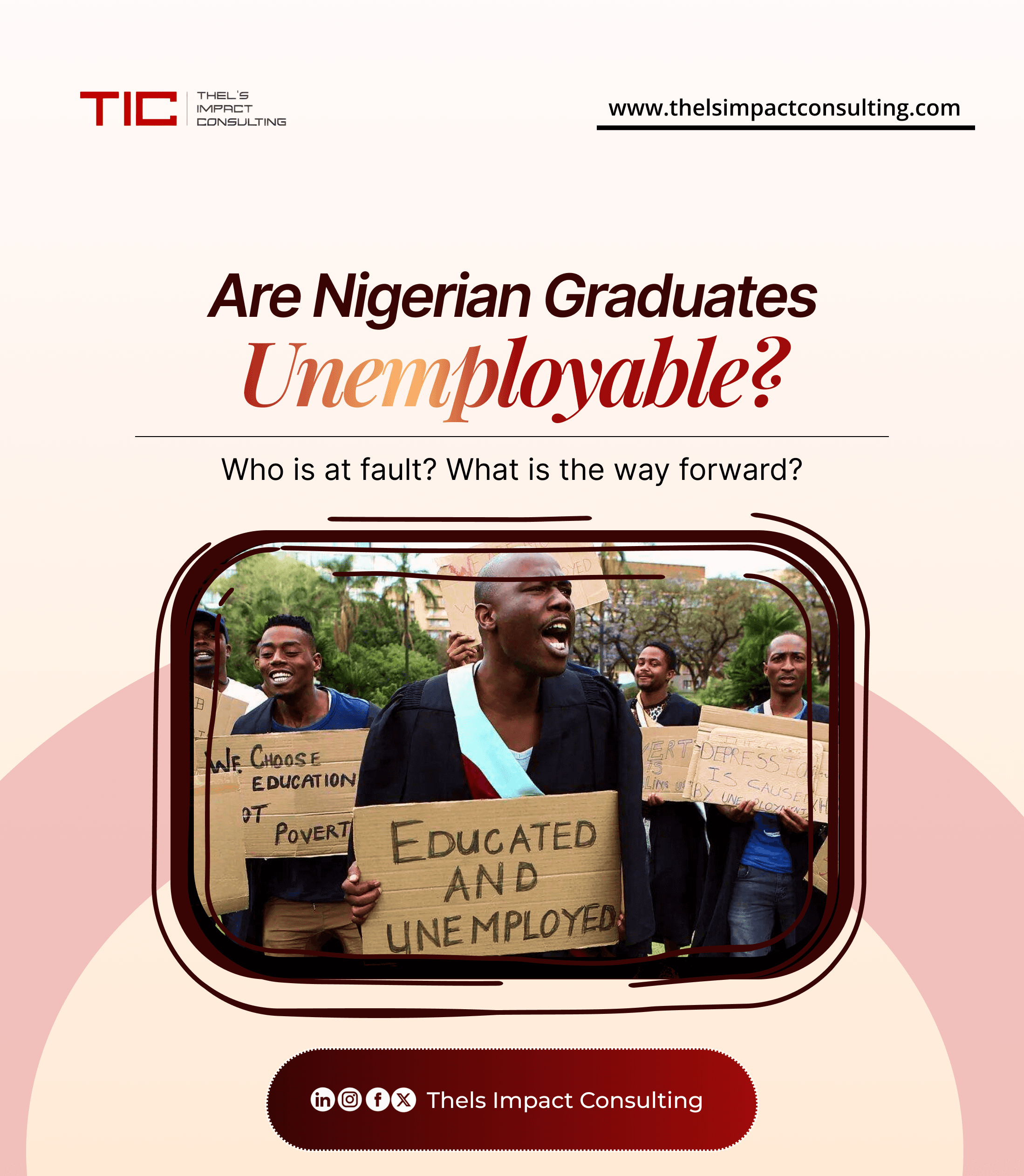
However, despite this increase in access, graduates from Nigerian universities still face significant challenges in securing jobs, with a lack of employability skills frequently cited as a key reason.
Many universities still operate with outdated curricula that place heavy emphasis on theory over practice. As a result, a good number of students graduate without adequate formal training that helps them apply theory efficiently.
As such, a pertinent question lingers: Are we truly learning, or just passing through the system?
Every year, over 1.5 to 2 million candidates sit for the Unified Tertiary Matriculation Examination (UTME). According to the National Universities Commission (NUC), Nigeria’s universities can only accommodate about 700,000 students out of over 2 million applicants annually. As a result, a significant number of graduates enter the labour market, competing for a limited number of skilled jobs.
The Issue at Hand
What we are witnessing is not just a graduate surplus but a skills deficit hidden inside academic success. On paper, the increase in access to education looks like progress, but in reality, the system is producing graduates faster than it is producing problem-solvers, innovators, and job-ready professionals.
A major issue lies in the disparity between what is taught and what is required. Most Nigerian tertiary institutions prioritise memorisation over application, theory over practice, and grades over competence. While it is important for students to graduate with strong GPAs, it is equally necessary that they acquire basic workplace skills such as writing professional emails, using industry tools, and thinking critically under pressure.
Imagine an Accounting graduate who does not know how to navigate Excel. Or a graduate of Linguistics who lacks proficiency in word processing tools. Meanwhile, their counterparts in other parts of the world are already using digital tools to solve the same problems they are still learning about theoretically.
Many departments also lack functional laboratories or modern equipment. In some cases, groups of students are required to share basic laboratory equipment such as microscopes, test tubes, beakers, and volumetric flasks, making it difficult to fully engage in practical work. Even where practical sessions exist, course content often fails to align with current industry trends. In addition, internships are sometimes poorly supervised, limiting their effectiveness.
Because of this, students spend four to five years preparing for exams, not for the real demands of the labour market. However, the labour market is not waiting. Employers want candidates who can demonstrate practical experience, adapt quickly, communicate clearly, think critically, and solve problems independently.
The Starting Point
Since the problem is clear, the next question is simple: where do we begin?
If Nigeria is serious about closing the gap between education and employability, the solution cannot be cosmetic. There must be a shift in what students learn and how institutions are structured to teach it.
Theoretical knowledge is important but beyond that, graduates now need a set of skills for the modern labour market. The times are changing. Graduating with a first-class degree no longer guarantees a white-collar job as it once did in the 1990s. Today, graduates must develop competencies that extend beyond the classroom. Graduates need to build skills beyond the classroom walls.
The following are important skills to develop:
Digital literacy and tool proficiency:
Every undergraduate should research tools relevant to their field and get comfortable with using them. Platforms like Google and AI tools like ChatGPT can support the process. Additionally, attending career-based conferences, even within campus environments, can provide exposure.
For example, a Management or Accounting student should be proficient in Excel, QuickBooks, and data visualisation tools. A Linguistics or English Language student should be able to use word processing tools, transcription software, and basic content management systems. Engineering students should engage with simulation tools and modern laboratory software.
Critical thinking and problem-solving:
Employers want people who can interpret problems. This means graduates should learn to analyse case studies instead of memorising definitions, work on real-life projects, not only exam-based questions, and make decisions with incomplete or evolving information.
For example, a newly employed website designer should not only know how to build a website but also understand how to create responsive designs that function across devices, solve user problems, and adapt to client needs rather than simply replicating templates.
Communication and workplace readiness:
You may have a high IQ but lack communication skills. Graduates must be able to communicate effectively with both superiors and subordinates. During interviews, HR professionals often test communication skills in real time. In many cases, strong academic performance alone is not enough if the candidate cannot communicate appropriately. Companies now look beyond technical competence to soft skills like communication.
Some key communication skills include:
Writing professional emails
Presenting ideas clearly in meetings
Collaborating in teams with structure and accountability
Furthermore, beyond what students can do individually, the Nigerian government and educational institutions must adopt better approaches to improve graduate employability. Nigeria does not need to reinvent the wheel. There are working models globally, especially in Germany that show how education can directly produce employable graduates.
For example, Germany operates a dual education system where students split time between classroom learning and paid apprenticeships in companies. As a result, in engineering, business, or technical fields, students not only learn theory but also work in actual companies during their education. By graduation, they already have work experience, industry connections and practical competence.
While Nigeria operates systems such as the Student Industrial Work Experience Scheme (SIWES) and Industrial Training (IT), these do not fully mirror the dual education system in Germany. It is a core part of the educational structure not an add-on. Students split their time consistently between classroom learning and paid work in companies, with both institutions and employers jointly responsible for training and assessment.
In contrast, Nigeria’s SIWES and IT programmes are often short-term, loosely supervised, and in some cases poorly aligned with students’ fields of study. Many students struggle to secure relevant placements, and even when they do, the experience may involve minimal hands-on engagement. As a result, what exists is exposure rather than integration. This gap explains why students can complete industrial training programmes and still graduate without the practical competence required in the labour market.
Conclusion
The issue is not that Nigerian students are not learning; it is that many are learning in isolation from reality.
The future belongs to graduates who can do more than pass exams. People who can deliver results.
At Thels Impact Consulting, we help you build the skills, experience, and confidence employers are looking for through structured internship programmes.
Position yourself ahead of the curve today.