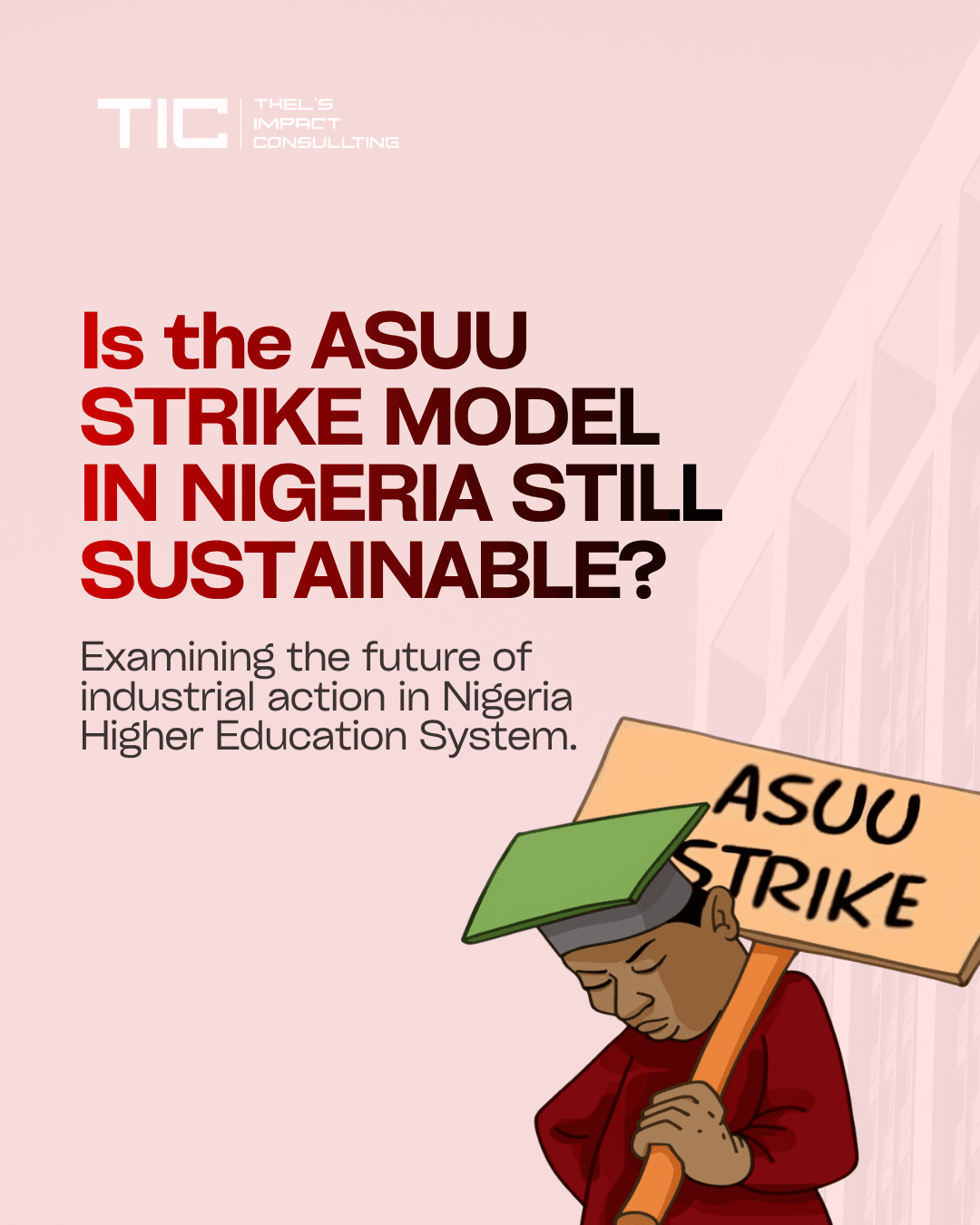
Is the ASUU Strike Model in Nigeria Still Sustainable? Examining the Future of Industrial Action in Nigeria’s Higher Education System
Following its National Executive Council (NEC) meeting held on August 8 and 9, 2026, the Academic Staff Union of Universities (ASUU) directed 20 university branches to issue 14-day ultimatums over what it described as the “haphazard implementation” of the 2025 Federal Government-ASUU Agreement.
Recent Happenings
Following its National Executive Council (NEC) meeting held on August 8 and 9, 2026, the Academic Staff Union of Universities (ASUU) directed 20 university branches to issue 14-day ultimatums over what it described as the “haphazard implementation” of the 2025 Federal Government-ASUU Agreement. If the issues remain unresolved after the ultimatum, the affected branches may proceed with industrial action.
The development has led us to uncomfortable but important questions, regarding ASUU’s strike model and whether this model is sustainable in achieving the demands of the union.
Understanding the ASUU Strike Model
Strike action is one of the strongest tools available to trade unions. It allows workers to withdraw their services when negotiations with employers fail to produce satisfactory outcomes.
For ASUU, however, strikes have historically gone beyond salaries. The union has consistently raised issues around university funding, staff welfare, earned allowances, infrastructure, university autonomy and the implementation of agreements reached with the government. A 2025 review by Ejenma et al., found that ASUU’s major disputes have often been connected to the government's failure to honour agreements, poor working conditions and inadequate funding. The study also notes that the union’s struggles have contributed to developments such as the establishment of TETFund and improvements in university infrastructure (Ejenma et al., 2025).
This makes the debate more complicated than simply asking whether ASUU should strike. Rather, we should be focused on the sustainability of this method of pressing demands, which has yielded no lasting solution in the past, and on identifying the most effective way to achieve these goals.
Why ASUU Strikes Have Continued
The 2025 FGN-ASUU Agreement was expected to provide a new foundation for industrial stability. The agreement, signed after years of negotiation, includes provisions relating to academic allowances, staff welfare, university funding and other conditions of service. The Federal Government has begun implementing key provisions of the agreement in federal universities, including the 40 per cent increase in academic staff emoluments and the CATA framework, while also inaugurating an Implementation Monitoring Committee in June 2026. However, the dispute persists largely because implementation has not been replicated across many state-owned universities. In July 2026, for example, the ASUU Kano Zone warned that it could resort to industrial action over delays in implementing the agreement in state-owned universities across Kano, Kaduna and Jigawa. Similarly, ASUU in Ondo State university has warned of possible industrial action over delays in implementing the agreement, particularly provisions relating to the Consolidated Academic Tools Allowance (CATA), Earned Academic Allowance (EAA) and Professorial Allowance.
ASUU has attributed this to the failure of several state governments to domesticate and implement the agreement, with some state governments reportedly claiming that the agreement was signed between the Federal Government and ASUU alone. This recurring disconnect between the parties involved in negotiations and those responsible for implementation has continued to fuel ASUU’s reliance on industrial action as a means of securing compliance.
The Cost of Prolonged Strikes
There is no doubt that strikes can put pressure on governments. However, the cost is rarely borne by the government alone. Students often bear the most immediate consequences. A 2024 study of students in selected universities in northeastern Nigeria found that more than 64% of respondents had experienced ASUU strikes during their university education, while 51.7% reported negative effects on their academic experience (Hassan & Shuaib, 2024). More broadly, repeated disruptions to the academic calendar can affect students’ learning continuity, delay graduation and create uncertainty around their academic and career plans. This creates a difficult policy dilemma. A strike may protect workers’ interests, but prolonged strikes can also disrupt the education of the very students the university system is designed to serve.
How Do We Rebuild the ASUU Strike System into a More Sustainable Approach? TIC’s Perspective
If the same cycle of negotiation, agreement, delayed implementation and renewed industrial action continues, the solution cannot be another agreement that simply resets the cycle. From TIC’s perspective, the focus should shift from managing individual strikes to reforming the system through which university labour disputes are negotiated and resolved.
1. Make Agreements Measurable and Trackable
The Federal Government has reached several agreements with ASUU over the years, yet disputes have repeatedly returned around implementation. TIC therefore recommends that every agreement should have a clear implementation framework setting out specific commitments, responsible institutions, deadlines, funding sources and measurable indicators. Progress should also be publicly tracked. The Federal Government’s establishment of an Implementation Monitoring Committee for the 2025 agreement is a step in this direction, but such monitoring should be built into agreements from the outset rather than introduced after implementation problems arise.
2. Make Every Responsible Government Accountable
The recurring disputes in state-owned universities expose a gap between who participates in negotiations and who is responsible for implementation. The 2026 disputes in states such as Ondo, Kano, Kaduna and Jigawa, demonstrate that a nationally negotiated agreement does not automatically produce uniform implementation across universities. TIC believes that agreements should therefore clearly assign obligations to every government and institution responsible for implementation. Where state governments are responsible for state-owned universities, their obligations should be explicit and independently trackable. This would reduce the ambiguity that allows parties to dispute responsibility after an agreement has been signed.
3. Create a Clear Path Before Industrial Action
TIC does not believe the answer is simply to ask ASUU to stop striking. Industrial action remains a legitimate tool of collective bargaining. However, there should be structured stages between a disagreement and a prolonged shutdown. An implementation dispute should move through joint review, independent mediation and, where appropriate, arbitration before industrial action becomes the final option. This would not remove ASUU's bargaining power; rather, it would ensure that every reasonable avenue for resolving a dispute has been exhausted before students lose weeks or months of academic time.
4. Put Students at the Centre of Industrial-Dispute Planning
Students are arguably the least powerful actors in the ASUU-government dispute, yet they often bear its most immediate consequences. Research has documented the disruption of academic calendars and students' educational progression during prolonged strikes. TIC therefore believes that student protection should become part of university industrial-relations policy. Where a strike becomes unavoidable, universities and governments should have an agreed Academic Continuity Plan covering examinations, graduation, clinical training, postgraduate research and other time-sensitive academic activities. The objective is not to undermine the right to strike, but to ensure that students do not become collateral damage in disputes they have no role in negotiating.
Nigeria's university system needs to move from a model that repeatedly reacts to industrial crises to one that anticipates implementation failures, assigns responsibility and resolves disputes before they escalate.
Conclusion
Nigeria’s university system needs to move from a model that repeatedly reacts to industrial crises to one that anticipates implementation failures, assigns responsibility and resolves disputes before they escalate.
Should Nigeria continue relying on strikes as a bargaining tool, or is it time to build a more sustainable model for resolving disputes in higher education?
For higher education leaders, questions like these are institutional challenges that require practical, context-specific solutions. If your institution is navigating a challenge in governance, strategy, policy, research, communication or institutional development, book a consultation session with TIC. Let’s work with you to understand the challenge, identify the right approach and develop solutions that move your institution forward. Click here to book a call