Recruitment Waiver Scrapped for Federal Universities: What Does It Imply?
On 17 October 2026, President Bola Tinubu, represented by the Executive Secretary of the Tertiary Education Trust Fund (TETFund), announced that the Federal Government had removed the requirement for federal universities to obtain recruitment waivers, presenting the decision as a step towards strengthening institutional autonomy and improving recruitment efficiency. (Federal Ministry of Information and National Orientation)
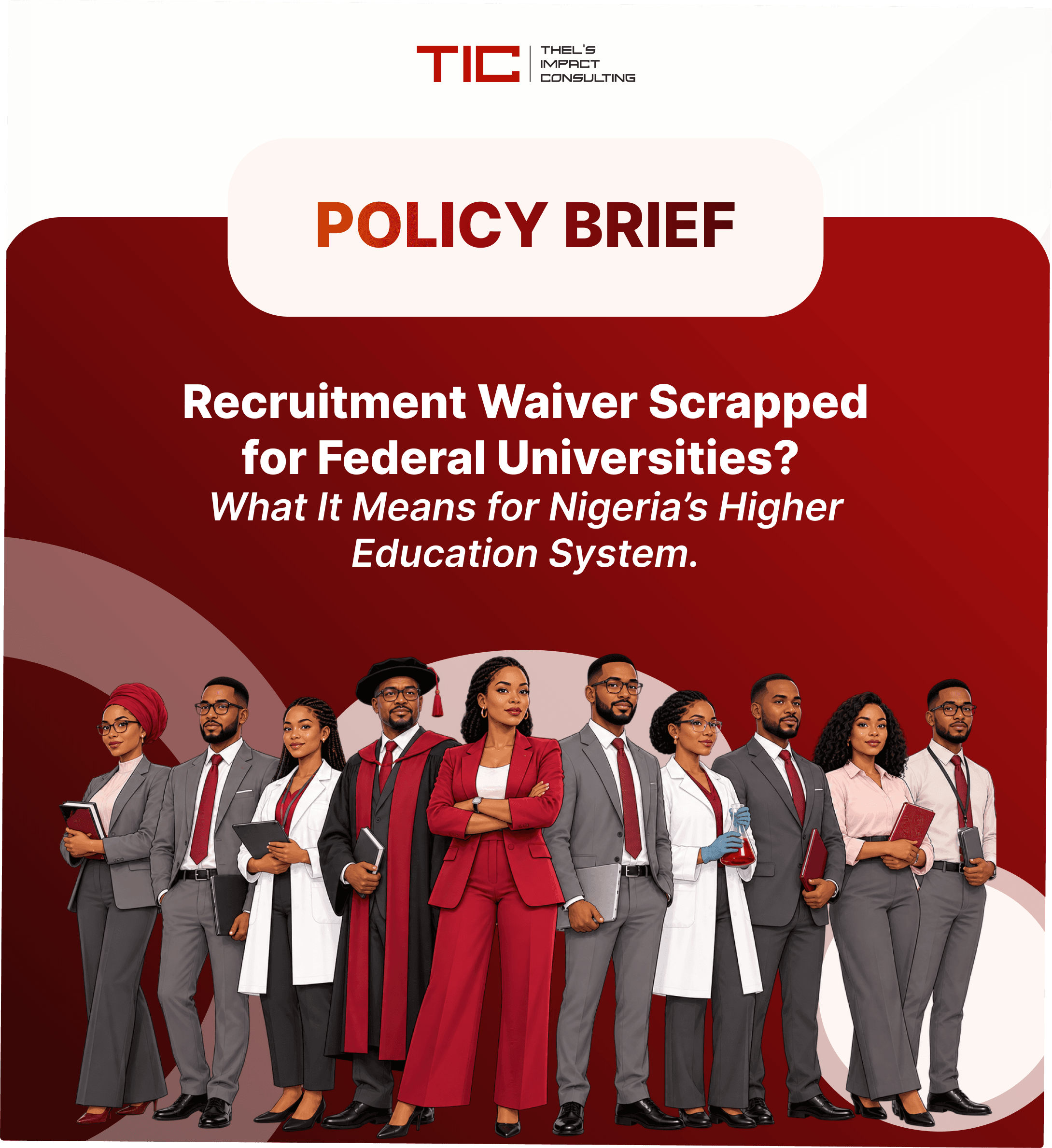
On 19 October, the Federal Ministry of Education clarified that the existing recruitment waiver process for federal tertiary institutions had not been abolished. The ministry explained that recruitment waiver requests remain subject to an approval committee chaired by the Minister of Education, while the Office of the Head of the Civil Service of the Federation retains responsibility for determining authorised staff establishments and assessing manpower requirements. (Official government clarification)
This clarification changes the immediate policy picture. Rather than an established removal of recruitment restrictions, the episode highlights an ongoing question about how Nigeria can balance university autonomy with public-sector accountability.
Why It Matters
Recruitment procedures directly affect universities’ ability to respond to staffing needs. Delays in filling vacancies can create challenges for teaching, research, student supervision and the delivery of specialised programmes.
The government’s stated rationale for the proposed change was to enable universities to respond more effectively to legitimate manpower needs and create an environment that supports teaching, research, innovation and national development. (Government announcement, 17 October 2026)
Yet the subsequent clarification means institutions must continue to operate within the existing approval framework. The policy challenge is therefore not simply whether to remove recruitment waivers, but how to make staffing decisions more responsive, transparent and sustainable.
What Could Change if Recruitment Restrictions Are Eased?
1. Faster responses to staffing gaps
If universities are eventually granted greater recruitment discretion, they could have more flexibility to fill vacancies and recruit professionals with specialised expertise. This could support teaching capacity, research teams and the introduction of relevant academic programmes. These are potential benefits, not confirmed outcomes of the current clarification.
2. Greater institutional autonomy
More control over recruitment could give university governing councils and management teams a stronger role in determining staffing priorities. However, meaningful autonomy requires clear decision-making powers and accountability mechanisms, not merely fewer administrative approvals.
3. Increased pressure on personnel budgets
Recruitment has long-term financial implications. On 20 October 2026, Punch Newspapers reported that the Minister of Education had raised concerns about rising manpower requests by federal universities, arguing that recruitment proposals must account for personnel costs, labour-market demand and national human-capital priorities. (Punch Newspapers report)
This raises an important consideration: expanding recruitment without sustainable funding could increase expenditure without necessarily improving educational outcomes.
4. Greater need for transparent recruitment
Any future relaxation of central approval requirements would make transparent vacancy announcements, merit-based selection, consistent recruitment criteria and auditable decisions especially important. These safeguards would help ensure that greater institutional discretion translates into stronger staffing decisions rather than inconsistent practices.
The Bigger Issue: Autonomy Must Be Matched by Capacity
The current episode exposes a broader governance challenge. Policy announcements, administrative procedures and implementation guidance must align if universities are to plan effectively.
The Ministry of Education’s clarification confirms that institutions must continue to follow the existing recruitment waiver process. (Federal Ministry of Information and National Orientation)
At the same time, the reported concerns about manpower requests point to the need for better alignment between institutional staffing plans, available funding and Nigeria’s workforce needs. (Punch Newspapers)
Universities need more than permission to recruit. They need the capacity to identify critical vacancies, attract qualified candidates, plan for personnel costs and demonstrate how staffing decisions support their academic and research mandates.
Policy Recommendations
Thels Impact Consulting recommends five priorities for strengthening recruitment governance in federal higher education:
Clarify recruitment rules: Publish consistent guidance on approval requirements, institutional responsibilities and the circumstances under which recruitment exemptions may apply.
Strengthen workforce planning: Require universities to support recruitment requests with evidence of vacancies, staffing gaps, programme requirements and projected personnel costs.
Protect merit and transparency: Maintain open recruitment processes, clear selection criteria and appropriate oversight of hiring decisions.
Connect recruitment to outcomes: Monitor whether staffing decisions improve teaching capacity, research productivity, staff retention and programme delivery.
Align recruitment with sustainable funding: Ensure that recruitment plans reflect credible financial projections and national human-capital priorities.
These recommendations are policy proposals from Thels Impact Consulting, informed by the issues raised in the government’s clarification and the reported concerns about university manpower requests.
Conclusion: The Real Test Is Better Universities
The recruitment waiver debate is about more than administrative procedures. It concerns how Nigeria governs, finances and strengthens its public universities.
Greater recruitment autonomy could help institutions respond more effectively to their needs. However, without clear rules, transparent selection and sustainable financing, additional discretion may not translate into better educational outcomes.
For now, the Ministry of Education has confirmed that the existing recruitment waiver process remains in force. (Official clarification, 19 October 2026)
The real measure of reform is not how many restrictions are removed, but whether universities become better equipped to teach, conduct research and contribute to Nigeria’s development.
Thels Impact Consulting provides insights into the policies, institutional decisions and funding arrangements shaping the future of higher education in Nigeria.