Nigeria Is Building Its Own Tertiary Education Ranking System: What It Means for Higher Education
On September 1, 2026, Nigeria’s Minister of Education, Dr. Tunji Alausa, made a big announcement. Read more below to find out more about this announcement.
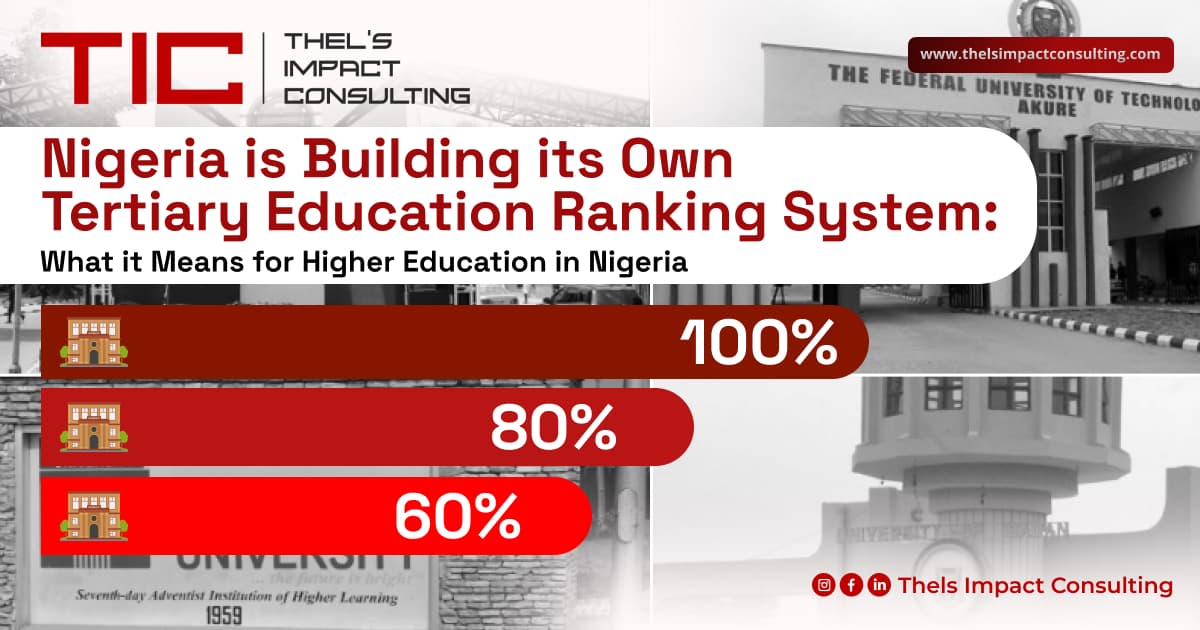
On September 1, 2026, Nigeria’s Minister of Education, Dr. Tunji Alausa, made a big announcement (TVC News, 2026). The government is building its own ranking system for tertiary institutions in Nigeria. This is something many people in Nigerian education have wanted for a long time.
The plan is bigger than most people expected. This system plans to include both universities, Polytechnics and Colleges of Education (Blueprint Newspapers, 2026). The committee behind it, once called the Nigerian Universities Ranking Advisory Committee (NURAC), has even been renamed the Nigerian Tertiary Education Ranking Advisory Committee to show its wider job (NAN, 2026). And participation is no longer optional. The first round, covering universities, starts this month, funded through TETFund (NAN, 2026). Polytechnics and colleges of education will join later, on a timeline the committee will decide (Naija News Break, 2026).
This is a big deal, and it’s worth asking why it’s happening now.
Why now?
The timing is not random. Nigeria just had its best year yet in the Times Higher Education (THE) World University Rankings 2026. Twenty-four Nigerian universities made the global list, up from 21 the year before. That’s the highest number from any country in Sub-Saharan Africa.
That sounds like good news, and it is. But it also shows a problem. Even Nigeria’s best universities are still ranked between 801 and 1000 globally (AllAfrica, 2026). They are competing against schools with far more money, better labs, and decades of research funding. Chasing rankings like THE or QS means playing a game built for institutions with a completely different kind of resources.
The minister said Nigeria needs a system that reflects its own institutions, its own environment, and its own priorities, not just how the rest of the world sees things (Legit.ng, 2026). That’s a fair point.
Why a national ranking system makes sense
International rankings are useful, but they’re not fair to everyone. They mostly reward things like published research, citations, and international recognition. A polytechnic that trains excellent, job-ready technicians for Nigeria’s factories will never show up on a THE list (Times Higher Education, 2026). And honestly, it shouldn’t have to. A ranking system built in Nigeria can measure things that actually matter here: how many graduates get good jobs, how much a school contributes to local industry, how good the teaching is, and how well public money is being used. That’s not a weaker version of a global ranking. It’s a different tool, and arguably a more useful one for Nigeria.
There’s also an accountability angle. Making this ranking compulsory, and funding it through TETFund as part of the wider Renewed Hope education reforms sends a message. This isn’t just for show. Many university leaders have operated for years with little outside scrutiny. Now they’ll have to go through a standard, comparable process. If done honestly, this could expose real problems, like staff shortages, poor funding decisions, weak research, and bad infrastructure, and force those issues into the open (NAN, 2026; TVC News, 2026).
But there are real concerns too
First, trust matters a lot for any ranking system. This one is being built by the same government ministry that funds and oversees these schools. That’s a conflict of interest. Will struggling federal universities be scored honestly, or will politics get in the way?
Second, we still don’t know the methodology. Nobody has said exactly what will be measured or how the data will be checked. Promises of “clear benchmarks” don’t mean much without details.
Third, there’s a risk this becomes just another bureaucratic exercise, more paperwork for already stretched schools, with no real results. Nigeria has seen plenty of good ideas stall after the first meeting.
And lastly, many HEIs in Nigeria lack effective M&E systems that are integrated into their operations, and as a result many HEIs would incur some financial and change management costs, alongside associated risk. However, this new direction is expedient as this will force them to set up M&E systems.
Where this leaves us
A national ranking system won’t fix everything wrong with Nigerian higher education. But it is a fair, and honestly overdue, attempt to judge success by Nigeria’s own standards, not by a scorecard made for Oxford or MIT. Whether it works will depend entirely on how it’s done: clear methods, independently checked data, and the courage to publish bad results about federal schools the ministry itself runs.
If the Nigerian Tertiary Education Ranking Advisory Committee gets this right, Nigeria will finally have a real tool to understand its 673 tertiary institutions, most of which will never appear on a global list but teach the majority of Nigerian students. If it gets it wrong, it becomes just another good idea that fades away.
Everyone with a stake in Nigerian education, teachers, researchers, employers, and policymakers, should watch this closely and push the ministry to publish its methods before this first round finishes. A ranking system built in secrecy will face the same doubts as the international ones. But one built in the open could genuinely change how Nigeria measures, and improves, its own schools.
The TIC Perspective
This is exactly the kind of moment Thels Impact Consulting (TIC) exists for. TIC is a HigherEd Tech consulting firm working to advance research and higher education in Africa, using educational technology, design thinking, and monitoring and evaluation frameworks to help universities, research institutes, and government bodies deliver on their mandates. As Nigerian Tertiary Education Ranking Advisory Committee moves from announcement to actual data collection, institutions will need exactly what TIC already builds: project management support and portfolio management to organize their research and institutional data for submission. TIC’s own Research in Nigeria (RIN) platform already tracks and showcases the state of Nigerian research and doctoral training, work that puts TIC in a strong position to support institutions preparing for this ranking exercise, and to help hold the process itself to a transparent, evidence-based standard.
Visit Research in Nigeria to discover more: https://researchinnigeria.org/